
A vision model reads a product photo the way a careful stranger would: it sees the
object, the brand marks, the wear, the connectors, and — crucially — any text printed
on the thing. That last part does most of the work. Which means the single highest-value
photo you can take for an
AI eBay listing tool isn’t the pretty
three-quarter hero shot. It’s a sharp, flat, glare-free close-up of the model plate.
What it reads reliably
From one decent photo, expect these to come back correct most of the time:
- Object class — laptop, ASIC miner, rack server, PLC module, drive caddy.
- Printed text — model numbers, OEM part numbers, hashrate stickers, wattage ratings, service tags, capacity markings. This is where identification actually comes from.
- Brand marks and badging, including the small silver ones on laptop palm rests.
- Connector and port layout — often the only way to tell one generation of a device from the next when the case is identical.
- Visible cosmetic condition — scuffs, dents, rack rash, corrosion, missing fascia, cracked plastic.
- What’s in the frame — one unit or six, cables included or not, whether the rails are there.
- Colour and finish, which matters more than you’d think for item specifics in fashion and homeware categories.
What it cannot read — ever
A photo is a record of light. It is not a record of function. These six things are
physically not in the image, and no amount of model quality changes that:
- Whether it powers on. The most consequential fact about a used item is invisible.
- Internal configuration. RAM, storage, CPU on a closed laptop or server. The chassis is the same whether there’s 8 GB or 64 GB inside.
- Battery health. A pristine-looking laptop can hold twenty minutes.
- Firmware and tuning. Stock or VNish, boosted or rated, factory settings or someone else’s overclock.
- Hours, cycles, or history. A miner that ran two years in a shed and one that ran two months look identical.
- Completeness. What should be in the box that isn’t — rails, PSU, caddies, stylus, original adapter.
Those six are your job on every single listing, forever. Everything else the software can
draft. If a tool fills any of them in confidently from a photo alone, it isn’t reading —
it’s guessing, and you’ll find out via a not-as-described case.
Shoot the label, not the item
Most sellers photograph the item beautifully and the label badly, then wonder why
identification is vague. Flip that priority. Six rules that fix nearly every misread:
-
One frame dedicated to the spec plate, shot square-on and filling the
frame. On an ASIC that’s the end-panel sticker. On a laptop it’s the base label. On a
Dell server it’s the pull-out service tag. On industrial gear it’s whatever’s stamped
or engraved into the casing. -
Kill the glare. Glossy and metallic labels blow out under a direct
ceiling light or a phone flash, and a blown-out label is unreadable text. Shoot at a
slight angle to the light source, or diffuse it. This one issue causes more bad
identifications than everything else combined. -
One item per photo. Two miners in frame and you get an averaged,
hedged description of neither. -
Include the port side for anything electronic. Generation differences
frequently live in the connectors, not the case. -
Photograph the damage separately and deliberately. A dedicated shot of
the dent gets it written into the condition description instead of quietly dropped. -
Never shoot through shrink wrap, anti-static bags, or a display case.
Reflections destroy exactly the text you need.
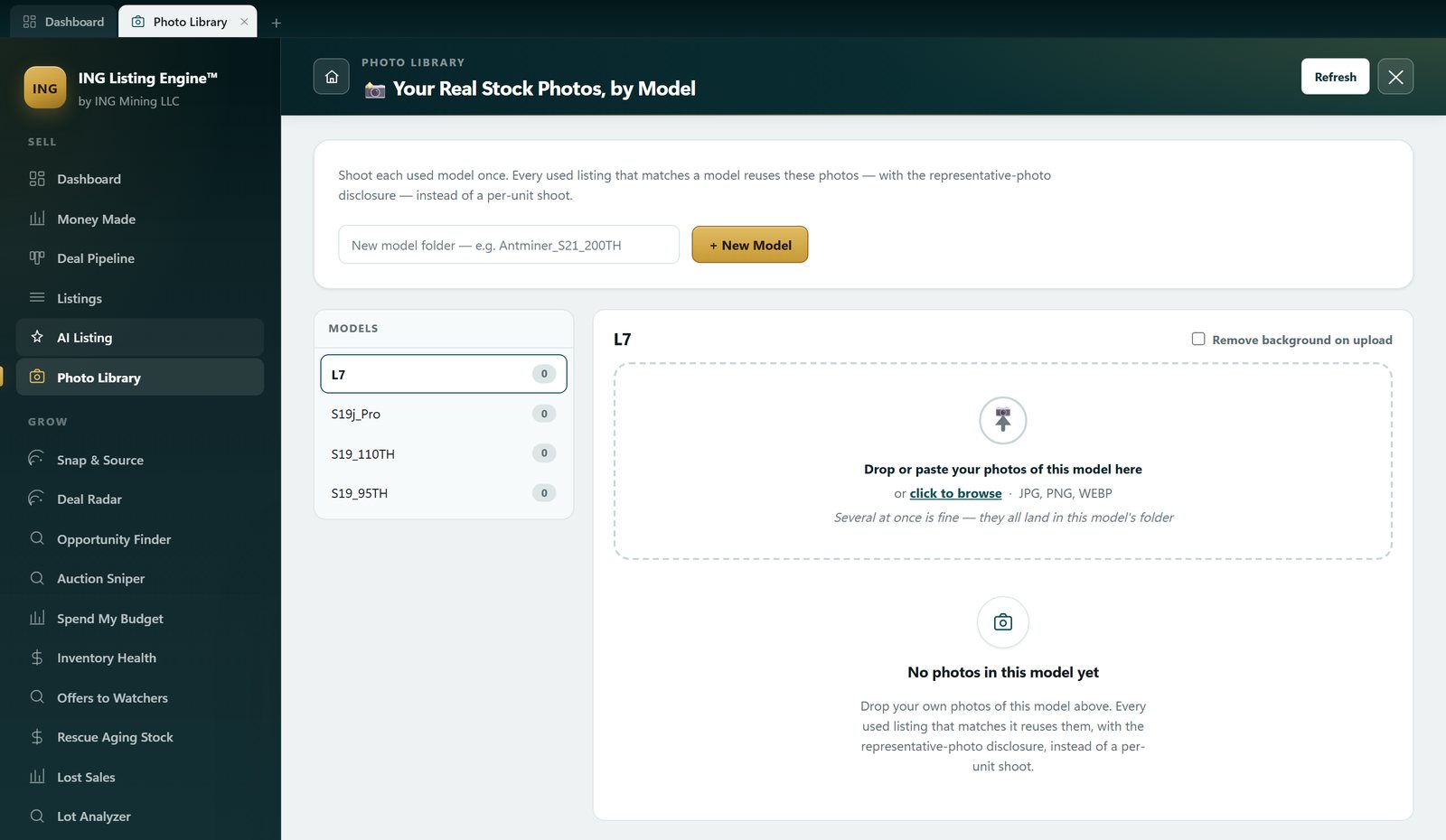
Photo Library keeps one folder per model — these are real folders from a miner
inventory, all still empty — and every used listing that matches a model reuses those
photos with a representative-photo disclosure attached, instead of a fresh shoot per
unit. Your own photos only. An AI-generated image is never an acceptable eBay listing
photo.
Sometimes typing beats photographing
Here’s the part vendors don’t advertise: for a mainstream catalogued product, typing the
model number is faster and more accurate than any photo. If you already know it’s a
ThinkPad T14 Gen 3, typing that gives the tool an unambiguous identity to work from and
removes the whole vision step — no glare, no angle, no ambiguity. That’s what
AI Quick-Fill is for.
Photo-first genuinely wins when you don’t know what you have. Pallet buys,
estate lots, unlabelled industrial parts, the box of adapters from a decommissioned rack.
That’s the case where a photo of the OEM number on the casing is the only route to an
identity at all — and it’s the case where fifteen minutes of manual research per item
makes low-value inventory not worth listing.
So the honest rule: photo for the unknown, typed model number for the known.
Most sellers have both, and most days you’ll use both.
Why a blank field is a good sign
When the tool leaves a field empty, that’s the design working. Given an ambiguous item,
a poorly-constrained model will produce a confident, plausible, wrong value — a RAM
figure, a wattage, a capacity — because plausible text is what language models are good
at. A well-constrained one returns nothing and waits for you.
Blank costs you ten seconds. Wrong costs you a return, the shipping both ways on a heavy
item, and a defect on your account. When you’re comparing tools, feed each one a
genuinely ambiguous item and see which one admits it doesn’t know. That single test tells
you more than any feature list.
The sixty-second review
Before you publish anything drafted from a photo, check these in order:
- Model number — read it off the actual item, not off the draft.
- Condition claim — did you personally test it? If not, don’t say “tested.”
- The six invisibles above — fill or explicitly disclaim each one that applies.
- Category — a two-second glance; a wrong category makes a listing invisible.
- Price against your cost basis — the comp median is the market’s number, not your floor. The what happens when you actually run a sold-comp query shows how badly unfiltered comps can miss.
Then publish. When you’re deciding what to source next rather than what to list next, the
Opportunity Finder is the other half of
this workflow.
Try it on the next awkward item you can’t identify. Drop a photo of the
spec plate in and see what comes back — the ING Listing Engine is free during the public
beta, for Windows, no paywall.
Download the ING Listing
Engine.
Common questions
How many photos does it need?
One will produce a draft. Two — a clear overall shot plus a square-on shot of the spec
plate — produce a noticeably better one. Beyond three or four you’re adding buyer-facing
photos, not identification signal.
Does photo quality matter more than camera quality?
Yes, by a wide margin. A modern phone in even, diffuse light beats an expensive camera
under a glaring ceiling bulb. Sharpness on the printed text is the only thing that
matters for identification; everything else is for the buyer.
Can it tell a genuine item from a counterfeit?
Not reliably, and you shouldn’t rely on it. It can flag obvious inconsistencies in
badging or finish, but authentication is a human judgment with real liability attached.
What about photos of an item still in its sealed box?
It’ll read the box label, which is usually enough to identify the product — but it can
say nothing about the contents. Describe it as sealed and unverified, because that’s
exactly what you know.